Certified Document Translation Services
Certified document translation service starts with evaluating accuracy standards, language expertise, and document acceptance by official institutions. A professional certified translation provider ensures precise language conversion for immigration, legal, academic, and government use while meeting strict certification requirements. Reliable services include signed accuracy statements, qualified linguists, and verifiable contact details. Reviewing credentials, turnaround times, pricing transparency, and client feedback helps identify a dependable provider. A trusted certified translation service delivers compliant documents that prevent delays, rejections, or costly revisions, ensuring smooth processing for official and international submissions.
ISO Certified 17100
Native Translators
Transparent Pricing
Twice Proofread
150+ Languages
Quote in 1 Hour


Free Certified Translation Quote
Our professional translation specialists will review your document and provide a fast, accurate quote for certified translation.
Official Document Translation for Popular Languages
Government agencies require verified records for immigration and university enrollment. Native-level proficiency ensures fidelity to the original text. United States Citizenship and Immigration Services (USIS), European consulates, and courts mandate accuracy in names, dates, and figures. Secure data handling protects personal information. Accredited agencies follow international authentication standards. Professional signatures, thorough proofreading, and proper validation ensure legal acceptance and successful cross-border processing.
European Languages Certified Translation Services
European languages certified translation services cover official documents (birth certificates, marriage licenses, and academic transcripts). Professional linguists deliver accurate renditions into languages including French, German, Spanish, and Italian. Official institutions require certified records for immigration, residency, and university admissions.
Certification statements guarantee fidelity to the source text, while native-level proficiency ensures precision. Regulatory bodies (United States Citizenship and Immigration Services), European consulates, and courts mandate verified translations. Meticulous proofreading eliminates errors in names and dates. Secure handling protects personal data. Accredited agencies follow international authentication standards, ensuring legal recognition, procedural compliance, and successful outcomes across borders.
French Certified Translation Services
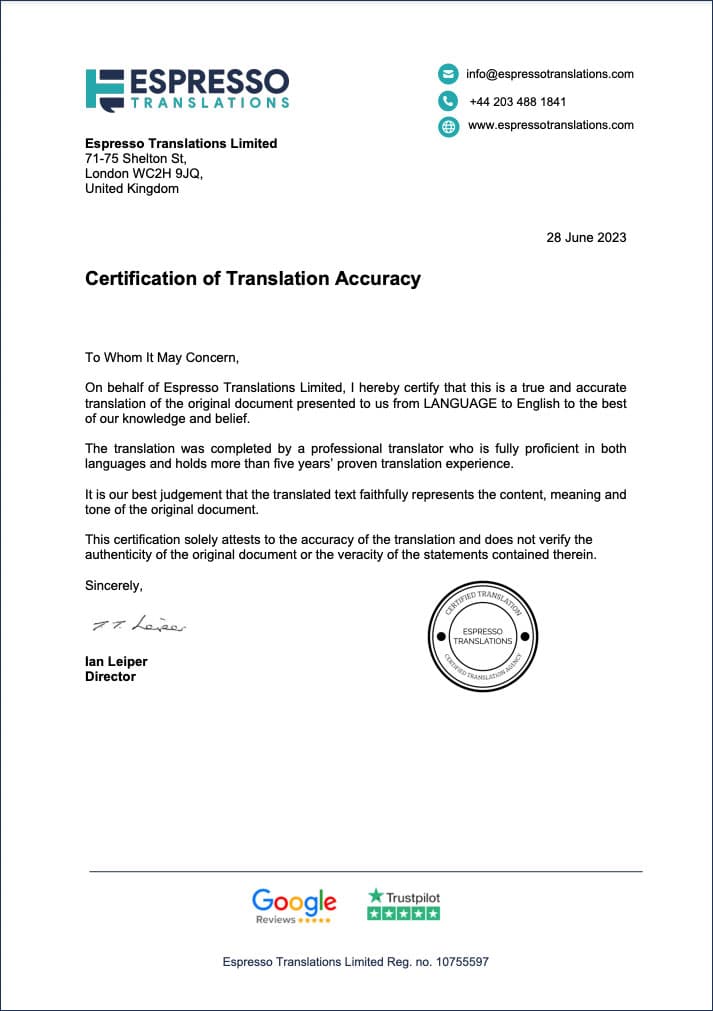
Official French translation services provide certified records for birth certificates and marriage licenses. Native linguists handle the work to ensure accuracy and cultural relevance. Each project includes a Certificate of Translation Accuracy to verify the validity of the work.
Key Steps
- Verify legibility. Intake staff check the clarity and total page counts of all records.
- Appoint translators. Project managers assign native French linguists to handle the task.
- Format layouts. Professional staff mirror the original design and add necessary seal annotations.
- Review content. Independent quality experts check for compliance and precision.
- Deliver files. Clients receive a digital PDF Certificate of Translation Accuracy.
Submission Tips
- Regional standards require specific attention to Canadian or European French styles.
- Official identification dictates the exact spelling of all names.
- Local jurisdictions determine requirements for digital or printed copies.
- Government offices necessitate verification of notarization or apostille status.
Common Certified Documents
Birth Certificate
Marriage Certificate
Divorce Decree
Death Certificate
Passport or ID Card
Driver’s License
Academic Record
Bank Statement
Court Order
Typical Use Cases
Immigration services
Legal proceedings
Education admissions
Financial transactions
Healthcare requirements
Need Expert Consultation?
Our French specialists are ready to discuss your project requirements and provide personalized recommendations. Contact a French expert now.
What to consider for a French certified translation?
Authority Requirements
Destination offices require specific verification steps (notarization or apostilles). Digital or physical copies follow rules set by the receiving agency.
Document Clarity
Legible scans capture all edges and official seals for the rendering process. Identity cards require images of both sides and all accompanying attachments.
Name Consistency
Names and dates match existing records to prevent processing delays. Specific transliteration rules apply to certain record types. Service features are included for every client request. Accuracy matters in every document conversion. Native linguists follow the mirrored layout requirements. Formatting reflects the original document design. Quality reviews form the structure of the standard process. Validation steps exist above the final delivery phase.
German Certified Translation Services
Official German translation services provide certified records for birth certificates and marriage licenses. Native linguists handle the work to ensure accuracy and cultural relevance. Each project includes a Certificate of Translation Accuracy to verify the validity of the work.
Key Steps
- Verify legibility. Intake staff check the clarity and total page counts of all records.
- Appoint translators. Project managers assign native German linguists to handle the task.
- Format layouts. Professional staff mirror the original design and add necessary seal annotations.
- Review content. Independent quality experts check for compliance and precision.
- Deliver files. Clients receive a digital PDF Certificate of Translation Accuracy.
Submission Tips
- Federal offices require high-resolution scans capturing all margins and official stamps.
- Reverse sides of documents need scanning if essential government endorsements exist.
- Local jurisdictions determine the necessity for physical paper copies with original wet signatures.
- Technical records require clear images to ensure the accuracy of complex terminology.
Common Certified Documents
Birth Certificate
Marriage Certificate
University Degree
Medical Report
Passport or ID Card
Driver’s License
Academic Record
Bank Statement
Court Order
Typical Use Cases
Immigration services
University admissions
Legal proceedings
Education admissions
Healthcare requirements
Need Expert Consultation?
Our German specialists are ready to discuss your project requirements and provide personalized recommendations.
What to consider for a German certified translation?
Authority Requirements
Destination offices require specific verification steps (notarization or official court appointments). Digital or physical copies follow the rules set by the receiving agency in Germany.
Document Clarity
Legible scans capture all edges and official seals for the rendering process. Identity cards require images of both sides and all accompanying attachments.
Name Consistency
Names and dates match existing records to prevent processing delays. Specific transliteration rules apply to certain record types. Service features are included for every client request. Accuracy matters in every document conversion. Native linguists follow the mirrored layout requirements. Formatting reflects the original document design. Quality reviews form the structure of the standard process. Validation steps exist above the final delivery phase.
Dutch Certified Translation Services
Official Dutch translation services provide certified records for adoption papers and tax records. Native linguists handle the work to ensure accuracy and cultural relevance. Each project includes a Certificate of Translation Accuracy to verify the validity of the work.
Key Steps
- Verify legibility. Intake staff check the clarity and total page counts of all records.
- Appoint translators. Project managers assign native Dutch linguists to handle the task.
- Format layouts. Professional staff mirror the original design and add necessary seal annotations.
- Review content. Independent quality experts check for compliance and precision.
- Deliver files. Clients receive a digital PDF Certificate of Translation Accuracy.
Submission Tips
- Administrative standards require specific attention to regional Netherlandish or Belgian styles.
- Official identification dictates the exact spelling of all names.
- Local jurisdictions determine requirements for digital or printed copies.
- Government offices necessitate verification of notarization or agency credentials.
Common Certified Documents
Adoption Papers
Tax Records
Police Clearance
Birth Certificate
Marriage Certificate
Divorce Decree
Academic Record
Bank Statement
Court Order
Typical Use Cases
Residency applications
Financial transactions
Legal proceedings
Education admissions
Employment background
Need Expert Consultation?
Our Dutch specialists are ready to discuss your project requirements and provide personalized recommendations.
What to consider for a Dutch certified translation?
Authority Requirements
Destination offices require specific verification steps (notarization or agency seals). Digital or physical copies follow the rules set by the receiving agency in the Netherlands.
Document Clarity
Legible scans capture all edges and official seals for the rendering process. Identity cards require images of both sides and all accompanying attachments.
Name Consistency
Names and dates match existing records to prevent processing delays. Specific transliteration rules apply to certain record types. Service features are included for every client request. Accuracy matters in every document conversion. Native linguists follow the mirrored layout requirements. Formatting reflects the original document design. Quality reviews form the structure of the standard process. Validation steps exist above the final delivery phase.
Spanish Certified Translation Services
Official Spanish translation services provide certified records for real estate deeds and employment contracts. Native linguists handle the work to ensure accuracy and cultural relevance. Each project includes a Certificate of Translation Accuracy to verify the validity of the work.
Key Steps
- Verify legibility. Intake staff check the clarity and total page counts of all records.
- Appoint translators. Project managers assign native Spanish linguists to handle the task.
- Format layouts. Professional staff mirror the original design and add necessary seal annotations.
- Review content. Independent quality experts check for compliance and precision.
- Deliver files. Clients receive a digital PDF Certificate of Translation Accuracy.
Submission Tips
- Regional standards require specific attention to European or Latin American Spanish styles.
- Official identification dictates the exact spelling of all names.
- Local jurisdictions determine requirements for digital or printed copies.
- Government offices necessitate verification of notarization or sworn status.
Common Certified Documents
Real Estate Deeds
Employment Contracts
Death Certificate
Birth Certificate
Marriage Certificate
Divorce Decree
Academic Record
Bank Statement
Court Order
Typical Use Cases
Property Purchases
Work permit applications
Inheritance matters
Education admissions
Legal proceedings
Need Expert Consultation?
Our Spanish specialists are ready to discuss your project requirements and provide personalized recommendations.
What to consider for a Spanish certified translation?
Authority Requirements
Destination offices require specific verification steps (notarization or apostilles). Digital or physical copies follow the rules set by the receiving agency in Spanish territories.
Document Clarity
Legible scans capture all edges and official seals for the rendering process. Identity cards require images of both sides and all accompanying attachments.
Name Consistency
Names and dates match existing records to prevent processing delays. Specific transliteration rules apply to certain record types. Service features are included for every client request. Accuracy matters in every document conversion. Native linguists follow the mirrored layout requirements. Formatting reflects the original document design. Quality reviews form the structure of the standard process. Validation steps exist above the final delivery phase.
Portuguese Certified Translation Services
Official Portuguese translation services provide certified records for business agreements and divorce decrees. Native linguists handle the work to ensure accuracy and cultural relevance. Each project includes a Certificate of Translation Accuracy to verify the validity of the work.
Key Steps
- Verify legibility. Intake staff check the clarity and total page counts of all records.
- Appoint translators. Project managers assign native Portuguese linguists to handle the task.
- Format layouts. Professional staff mirror the original design and add necessary seal annotations.
- Review content. Independent quality experts check for compliance and precision.
- Deliver files. Clients receive a digital PDF Certificate of Translation Accuracy.
Key Considerations
- Regional standards require specific attention to European or Brazilian Portuguese styles.
- Official identification dictates the exact spelling of all names.
- Local jurisdictions determine requirements for digital or printed copies.
- Government offices necessitate verification of notarization or professional seals.
Available Translation Types
Business Agreements
Divorce Decree
University Degree
Birth Certificate
Marriage Certificate
Death Certificate
Academic Record
Bank Statement
Court Order
Typical Use Cases
Corporate registration
Family law matters
Education admissions
Immigration services
Financial transactions
Need Expert Consultation?
Our Portuguese specialists are ready to discuss your project requirements and provide personalized recommendations.
What to consider for a Portuguese certified translation?
Authority Requirements
Destination offices require specific verification steps such as notarization or apostilles. Digital or physical copies follow rules set by the receiving agency in Portugal or Brazil.
Document Clarity
Legible scans capture all edges and official seals for the rendering process. Identity cards require images of both sides and all accompanying attachments.
Name Consistency
Names and dates match existing records to prevent processing delays. Specific transliteration rules apply to certain record types. Service features are included for every client request. Accuracy matters in every document conversion. Native linguists follow the mirrored layout requirements. Formatting reflects the original document design. Quality reviews form the structure of the standard process. Validation steps exist above the final delivery phase.
Italian Certified Translation Services
Official Italian translation services provide certified records for family booklets and court orders. Native linguists handle the work to ensure accuracy and cultural relevance. Each project includes a signed declaration to verify the professional validity of the work.
Key Steps
- Verify legibility. Intake staff check the clarity and total page counts of all records.
- Appoint translators. Project managers assign native Italian linguists to handle the task.
- Format layouts. Professional staff mirror the original design and add necessary seal annotations.
- Review content. Independent quality experts check for compliance and precision.
- Deliver files. Clients receive a digital PDF certificate to verify the official results.
Submission Tips
- Consular offices require specific attention to the intended regional use of records.
- Official identification dictates the exact spelling of all personal names involved.
- Local jurisdictions determine requirements for digital or printed copies for court submission.
- Government offices necessitate verification of professional standing or agency credentials.
Common Certified Documents
Family Booklets
Court Judgments
Birth Certificates
Marriage Licenses
Academic Records
Police Clearances
Property Deeds
Bank Statements
Death Certificates
Typical Use Cases
Citizenship applications
Legal proceedings
Education admissions
Property transactions
Insurance requirements
Need Expert Consultation?
Our Italian specialists are ready to discuss your project requirements and provide personalized recommendations.
What to consider for an Italian certified translation?
Authority Requirements
Destination offices require specific verification steps such as notarization or apostilles. Digital or physical copies follow rules set by the receiving agency in Italy or abroad.
Document Clarity
Legible scans capture all edges and official seals for the rendering process. Identity cards require images of both sides and all accompanying attachments for verification.
Name Consistency
Names and dates match existing records to prevent processing delays. Specific transliteration rules apply to certain record types. Service features are included in the structure above for every client request. Accuracy matters in every document conversion. Native linguists follow the mirrored layout requirements. Formatting reflects the original document design. Quality reviews form the structure of the standard process. Validation steps exist above the final delivery phase.
Russian Certified Translation Services
Official Russian translation services provide certified records for internal passports and scientific papers. Native linguists handle the work to ensure accuracy and cultural relevance. Each project includes a signed declaration to verify the validity of the work.
Key Steps
- Verify legibility. Intake staff check the clarity and total page counts of all records.
- Appoint translators. Project managers assign native Russian linguists to handle the task.
- Format layouts. Professional staff mirror the original design and add necessary seal annotations.
- Review content. Independent quality experts check for compliance and precision.
- Deliver files. Clients receive a digital PDF certificate to confirm the professional results.
Submission Tips
- Consular offices require specific transliteration of names into the Latin alphabet.
- Official identification dictates the exact spelling of all names on the documents.
- Local jurisdictions determine requirements for digital or printed copies for legal use.
- Government offices necessitate verification of the translator’s qualifications for Cyrillic records.
Common Certified Documents
Internal Passports
Birth Certificates
Academic Diplomas
Military Records
Medical Certificates
Employment Records
Patent Documents
Police Checks
Power of Attorney
Typical Use Cases
Immigration services
Academic enrollment
Employment background
Medical treatment
Patent filings
Need Expert Consultation?
Our Russian specialists are ready to discuss your project requirements and provide personalized recommendations.
What to consider for a Russian certified translation?
Authority Requirements
Destination offices require specific verification steps and notarization for official use. Digital or physical copies follow the rules set by the receiving agency for Russian files.
Document Clarity
Legible scans capture all edges and official seals for the rendering process. Identity cards require images of both sides and all accompanying attachments for total accuracy.
Name Consistency
Names and dates match existing records to prevent processing delays. Specific transliteration rules apply to certain record types. Service features are included in the structure above for every client request. Accuracy matters in every document conversion. Native linguists follow the mirrored layout requirements. Formatting reflects the original document design. Quality reviews form the structure of the standard process. Validation steps exist above the final delivery phase.
English Certified Translation Services
Official English translation services provide certified records for immigration forms and insurance policies. Native linguists handle the work to ensure accuracy and cultural relevance. Each project includes a certificate of accuracy to verify the validity of the work.
Key Steps
- Verify legibility. Intake staff check the clarity and total page counts of all records.
- Appoint translators. Project managers assign native English linguists to handle the task.
- Format layouts. Professional staff mirror the original design and add necessary seal annotations.
- Review content. Independent quality experts check for compliance and precision.
- Deliver files. Clients receive a digital PDF certificate to verify the official results.
Submission Tips
- International standards require specific attention to British or American English styles.
- Official identification dictates the exact spelling of all names for government records.
- Local jurisdictions determine requirements for digital or printed copies for administrative use.
- Government offices necessitate verification of the agency’s professional standing and seals.
Common Certified Documents
Immigration Forms
Insurance Policies
Birth Certificates
Marriage Licenses
Academic Transcripts
Professional Licenses
Financial Statements
Legal Affidavits
Business Contracts
Typical Use Cases
Visa applications
Legal proceedings
Education admissions
Financial transactions
Employment requirements
Need Expert Consultation?
Our English specialists are ready to discuss your project requirements and provide personalized recommendations.
What to consider for an English certified translation?
Authority Requirements
Destination offices require specific verification steps (notarization) for foreign entities. Digital or physical copies follow rules set by the receiving agency for English records.
Document Clarity
Legible scans capture all edges and official seals for the rendering process. Identity cards require images of both sides and all accompanying attachments for official review.
Name Consistency
Names and dates match existing records to prevent processing delays. Specific transliteration rules apply to certain record types. Service features are included in the structure above for every client request. Accuracy matters in every document conversion. Native linguists follow the mirrored layout requirements. Formatting reflects the original document design. Quality reviews form the structure of the standard process. Validation steps exist above the final delivery phase.
Greek Certified Translation Services
Official Greek translation services provide certified records for property titles and baptismal certificates. Native linguists handle the work to ensure accuracy and cultural relevance. Each project includes a signed declaration to verify the validity of the work.
Key Steps
- Verify legibility. Intake staff check the clarity and total page counts of all records.
- Appoint translators. Project managers assign native Greek linguists to handle the task.
- Format layouts. Professional staff mirror the original design and add necessary seal annotations.
- Review content. Independent quality experts check for compliance and precision.
- Deliver files. Clients receive a digital PDF certificate to verify the official results.
Submission Tips
- Regional standards require specific attention to specialized legal or religious terminology.
- Official identification dictates the exact spelling of all names for consular use.
- Local jurisdictions determine requirements for digital or printed copies for property deals.
- Government offices necessitate verification of the translator’s official court registration.
Common Certified Documents
Property Titles
Baptismal Certificates
Military Records
Birth Certificates
Marriage Licenses
Academic Degrees
Business Licenses
Court Orders
Family Booklets
Typical Use Cases
Property transactions
Citizenship services
Military exemptions
Education admissions
Family law matters
Need Expert Consultation?
Our Greek specialists are ready to discuss your project requirements and provide personalized recommendations.
What to consider for a Greek certified translation?
Authority Requirements
Destination offices require specific verification steps (notarization or apostilles). Digital or physical copies follow rules set by the receiving agency in Greek territory.
Document Clarity
Legible scans capture all edges and official seals for the rendering process. Identity cards require images of both sides and all accompanying attachments for legal validity.
Name Consistency
Names and dates match existing records to prevent processing delays. Specific transliteration rules apply to certain record types. Service features are included in the structure above for every client request. Accuracy matters in every document conversion. Native linguists follow the mirrored layout requirements. Formatting reflects the original document design. Quality reviews form the structure of the standard process. Validation steps exist above the final delivery phase.
Turkish Certified Translation Services
Official Turkish translation services provide certified records for identity cards and export permits. Native linguists handle the work to ensure accuracy and cultural relevance. Each project includes a signed statement to verify the validity of the work.
Key Steps
- Verify legibility. Intake staff check the clarity and total page counts of all records.
- Appoint translators. Project managers assign native Turkish linguists to handle the task.
- Format layouts. Professional staff mirror the original design and add necessary seal annotations.
- Review content. Independent quality experts check for compliance and precision.
- Deliver files. Clients receive a digital PDF certificate to confirm the official results.
Submission Tips
- Administrative standards require specific attention to formal governmental or trade terminology.
- Official identification dictates the exact spelling of all names for residency permits.
- Local jurisdictions determine requirements for digital or printed copies for business use.
- Government offices necessitate verification of the agency’s professional standing in Turkey.
Common Certified Documents
Identity Cards
Export Permits
Bank Books
Birth Certificates
Marriage Contracts
School Reports
Business Licenses
Police Certificates
Name Change Documents
Industries Served:
Residency permits
International trade
Education admissions
Legal proceedings
Financial transactions
Need Expert Consultation?
Our Turkish specialists are ready to discuss your project requirements and provide personalized recommendations.
What to consider for a Turkish certified translation?
Authority Requirements
Destination offices require specific verification steps (notarization) for official recognition. Digital or physical copies follow rules set by the receiving agency in Turkish jurisdictions.
Document Clarity
Legible scans capture all edges and official seals for the rendering process. Identity cards require images of both sides and all accompanying attachments for official verification.
Name Consistency
Names and dates match existing records to prevent processing delays. Specific transliteration rules apply to certain record types. Service features are included in the structure above for every client request. Accuracy matters in every document conversion. Native linguists follow the mirrored layout requirements. Formatting reflects the original document design. Quality reviews form the structure of the standard process. Validation steps exist above the final delivery phase.
Swedish Certified Translation Services
Official Swedish translation services provide certified records for residence permits and power of attorney. Native linguists handle the work to ensure accuracy and cultural relevance. Each project includes a Certificate of Translation Accuracy to verify the validity of the work.
Key Steps
- Verify legibility. Intake staff check the clarity and total page counts of all records.
- Appoint translators. Project managers assign native Swedish linguists to handle the task.
- Format layouts. Professional staff mirror the original design and add necessary seal annotations.
- Review content. Independent quality experts check for compliance and precision.
- Deliver files. Clients receive a digital PDF Certificate of Translation Accuracy.
Submission Tips
- Nordic standards require specific attention to technical, legal, or medical terminology.
- Official identification dictates the exact spelling of all names for immigration use.
- Local jurisdictions determine requirements for digital or printed copies for healthcare.
- Government offices necessitate verification of the translator’s official status or agency credentials.
Common Certified Documents
Residence Permits
Power of Attorney
Medical Certificates
Birth Records
Marriage Certificates
Academic Diplomas
Employment Records
Tax Documents
Death Certificates
Typical Use Cases
Residency applications
Legal representation
Healthcare services
Education admissions
Financial verification
Need Expert Consultation?
Our Swedish specialists are ready to discuss your project requirements and provide personalized recommendations.
What to consider for a Swedish certified translation?
Authority Requirements
Destination offices require specific verification steps (notarization or professional stamps). Digital or physical copies follow the rules set by the receiving agency in Swedish territories.
Document Clarity
Legible scans capture all edges and official seals for the rendering process. Identity cards require images of both sides and all accompanying attachments for professional review.
Name Consistency
Names and dates match existing records to prevent processing delays. Specific transliteration rules apply to certain record types. Service features are included in the structure above for every client request. Accuracy matters in every document conversion. Native linguists follow the mirrored layout requirements. Formatting reflects the original document design. Quality reviews form the structure of the standard process. Validation steps exist above the final delivery phase.
Asian Languages Certified Translation Services
Administrative bodies United States Citizenship and Immigration Services, educational boards, and courts require verified records for immigration and academic use. Certification statements confirm authenticity for international authorities. Accredited agencies ensure accountability, data security, and accurate rendering of names and dates. Rigorous proofreading and validation prevent rejection. Professional verification guarantees legal recognition, regulatory compliance, and smooth acceptance across global administrative systems.
Chinese Certified Translation Services
Official Chinese translation services provide certified records for household registers and business licenses. Native linguists handle the work to ensure accuracy and cultural relevance. Each project includes a certificate of accuracy to verify the validity of the work.
Key Steps
- Verify legibility. Intake staff check the clarity and total page counts of all records.
- Appoint translators. Project managers assign native Chinese linguists to handle the task.
- Format layouts. Professional staff mirror the original design and add necessary seal annotations.
- Review content. Independent quality experts check for compliance and precision.
- Deliver files. Clients receive a digital PDF certificate to verify the official results.
Submission Tips
- Regional standards require specific attention to Simplified or Traditional Chinese scripts.
- Official identification dictates the exact spelling of all names for consular processing.
- Local jurisdictions determine requirements for digital or printed copies for commercial use.
- Government offices necessitate verification of the agency’s official stamps and registration.
Common Certified Documents
Household Registers
Business Licenses
Export Permits
Birth Certificates
Marriage Contracts
Degree Certificates
Articles of Association
Financial Records
Property Deeds
Typical Use Cases
Immigration services
Corporate registration
Education admissions
International trade
Legal proceedings
Need Expert Consultation?
Our Chinese specialists are ready to discuss your project requirements and provide personalized recommendations.
What to consider for a Chinese certified translation?
Authority Requirements
Destination offices require specific verification steps (notarization or agency seals). Digital or physical copies follow the rules set by the receiving agency for Chinese records.
Document Clarity
Legible scans capture all edges and official seals for the rendering process. Identity cards require images of both sides and all accompanying attachments for total precision.
Name Consistency
Names and dates match existing records to prevent processing delays. Specific transliteration rules apply to certain record types. Service features are included in the structure above for every client request. Accuracy matters in every document conversion. Native linguists follow the mirrored layout requirements. Formatting reflects the original document design. Quality reviews form the structure of the standard process. Validation steps exist above the final delivery phase.
Arabic Certified Translation Services
Official Arabic translation services provide certified records for marriage contracts and birth records. Native linguists handle the work to ensure accuracy and cultural relevance. Each project includes a certificate of accuracy to verify the validity of the work.
Key Steps
- Verify legibility. Intake staff check the clarity and total page counts of all records.
- Appoint translators. Project managers assign native Arabic linguists to handle the task.
- Format layouts. Professional staff mirror the original design and add necessary seal annotations.
- Review content. Independent quality experts check for compliance and precision.
- Deliver files. Clients receive a digital PDF certificate to verify the official results.
Submission Tips
- Regional standards require specific attention to regional dialects or formal Modern Standard Arabic.
- Official identification dictates the exact spelling of all names for visa processing.
- Local jurisdictions determine requirements for digital or printed copies for court use.
- Government offices necessitate verification of the agency’s professional standing and stamps.
Common Certified Documents
Marriage Contracts
Birth Records
Court Judgments
Death Certificates
Identity Documents
Academic Degrees
Bank Statements
Property Titles
Power of Attorney
Typical Use Cases
Immigration services
Legal proceedings
Education admissions
Family law matters
Financial transactions
Need Expert Consultation?
Our Arabic specialists are ready to discuss your project requirements and provide personalized recommendations.
What to consider for an Arabic certified translation?
Authority Requirements
Destination offices require specific verification steps (notarization) for official recognition. Digital or physical copies follow the rules set by the receiving agency for Arabic files.
Document Clarity
Legible scans capture all edges and official seals for the rendering process. Identity cards require images of both sides and all accompanying attachments for official verification.
Name Consistency
Names and dates match existing records to prevent processing delays. Specific transliteration rules apply to certain record types. Service features are included in the structure above for every client request. Accuracy matters in every document conversion. Native linguists follow the mirrored layout requirements. Formatting reflects the original document design. Quality reviews form the structure of the standard process. Validation steps exist above the final delivery phase.
Hebrew Certified Translation Services
Official Hebrew translation services provide certified records for military service records and identity papers. Native linguists handle the work to ensure accuracy and cultural relevance. Each project includes a certificate of accuracy to verify the validity of the work.
Key Steps
- Verify legibility. Intake staff check the clarity and total page counts of all records.
- Appoint translators. Project managers assign native Hebrew linguists to handle the task.
- Format layouts. Professional staff mirror the original design and add necessary seal annotations.
- Review content. Independent quality experts check for compliance and precision.
- Deliver files. Clients receive a digital PDF certificate to verify the official results.
Submission Tips
- National standards require specific attention to formal legal or military terminology.
- Official identification dictates the exact spelling of all names for consular use.
- Local jurisdictions determine requirements for digital or printed copies for residency.
- Government offices necessitate verification of the translator’s official status in Israel.
Common Certified Documents
Military Records
Identity Papers
Academic Transcripts
Birth Certificates
Marriage Licenses
Medical Certificates
Financial Records
Court Orders
Property Deeds
Typical Use Cases
Immigration services
Military verification
Education admissions
Legal proceedings
Financial transactions
Need Expert Consultation?
Our Hebrew specialists are ready to discuss your project requirements and provide personalized recommendations.
What to consider for a Hebrew certified translation?
Authority Requirements
Destination offices require specific verification steps (notarization or professional seals). Digital or physical copies follow rules set by the receiving agency for Hebrew records.
Document Clarity
Legible scans capture all edges and official seals for the rendering process. Identity cards require images of both sides and all accompanying attachments for official review.
Name Consistency
Names and dates match existing records to prevent processing delays. Specific transliteration rules apply to certain record types. Service features are included in the structure above for every client request. Accuracy matters in every document conversion. Native linguists follow the mirrored layout requirements. Formatting reflects the original document design. Quality reviews form the structure of the standard process. Validation steps exist above the final delivery phase.
Japanese Certified Translation Services
Official Japanese translation services provide certified records for family registries and corporate bylaws. Native linguists handle the work to ensure accuracy and cultural relevance. Each project includes a certificate of accuracy to verify the validity of the work.
Key Steps
- Verify legibility. Intake staff check the clarity and total page counts of all records.
- Appoint translators. Project managers assign native Japanese linguists to handle the task.
- Format layouts. Professional staff mirror the original design and add necessary seal annotations.
- Review content. Independent quality experts check for compliance and precision.
- Deliver files. Clients receive a digital PDF certificate to verify the official results.
Submission Tips
- Administrative standards require specific attention to Koseki formatting or technical trade terms.
- Official identification dictates the exact spelling of all names for residency permits.
- Local jurisdictions determine requirements for digital or printed copies for business use.
- Government offices necessitate verification of the agency’s professional standing in Japan.
Common Certified Documents
Family Registries
Corporate Bylaws
Patent Filings
Birth Certificates
Marriage Records
Academic Diplomas
Bank Records
Driver’s Licenses
Employment Certificates
Typical Use Cases
Immigration services
Corporate registration
Patent applications
Education admissions
Legal proceedings
Need Expert Consultation?
Our Japanese specialists are ready to discuss your project requirements and provide personalized recommendations.
What to consider for a Japanese certified translation?
Authority Requirements
Destination offices require specific verification steps (notarization or agency seals). Digital or physical copies follow the rules set by the receiving agency for Japanese records.
Document Clarity
Legible scans capture all edges and official seals for the rendering process. Identity cards require images of both sides and all accompanying attachments for official verification.
Name Consistency
Names and dates match existing records to prevent processing delays. Specific transliteration rules apply to certain record types. Service features are included in the structure above for every client request. Accuracy matters in every document conversion. Native linguists follow the mirrored layout requirements. Formatting reflects the original document design. Quality reviews form the structure of the standard process. Validation steps exist above the final delivery phase.
Urdu Certified Translation Services
Official Urdu translation services provide certified records for Nikah Namas and land records. Native linguists handle the work to ensure accuracy and cultural relevance. Each project includes a certificate of accuracy to verify the validity of the work.
Key Steps
- Verify legibility. Intake staff check the clarity and total page counts of all records.
- Appoint translators. Project managers assign native Urdu linguists to handle the task.
- Format layouts. Professional staff mirror the original design and add necessary seal annotations.
- Review content. Independent quality experts check for compliance and precision.
- Deliver files. Clients receive a digital PDF certificate to verify the official results.
Submission Tips
- Regional standards require specific attention to formal legal or religious terminology.
- Official identification dictates the exact spelling of all names for visa processing.
- Local jurisdictions determine requirements for digital or printed copies for property use.
- Government offices necessitate verification of the agency’s professional standing and stamps.
Common Certified Documents
Nikah Namas
Land Records
Academic Certificates
Birth Records
Identity Cards
Financial Records
Death Certificates
Power of Attorney
Police Clearances
Typical Use Cases
Immigration services
Legal proceedings
Education admissions
Property transactions
Financial transactions
Need Expert Consultation?
Our Urdu specialists are ready to discuss your project requirements and provide personalized recommendations.
What to consider for an Urdu certified translation?
Authority Requirements
Destination offices require specific verification steps (notarization) for official recognition. Digital or physical copies follow the rules set by the receiving agency for Urdu files.
Document Clarity
Legible scans capture all edges and official seals for the rendering process. Identity cards require images of both sides and all accompanying attachments for official verification.
Name Consistency
Names and dates match existing records to prevent processing delays. Specific transliteration rules apply to certain record types. Service features are included in the structure above for every client request. Accuracy matters in every document conversion. Native linguists follow the mirrored layout requirements. Formatting reflects the original document design. Quality reviews form the structure of the standard process. Validation steps exist above the final delivery phase.
Thai Certified Translation Services
Official Thai translation services provide certified records for house registrations and name change certificates. Native linguists handle the work to ensure accuracy and cultural relevance. Each project includes a certificate of accuracy to verify the validity of the work.
Key Steps
- Verify legibility. Intake staff check the clarity and total page counts of all records.
- Appoint translators. Project managers assign native Thai linguists to handle the task.
- Format layouts. Professional staff mirror the original design and add necessary seal annotations.
- Review content. Independent quality experts check for compliance and precision.
- Deliver files. Clients receive a digital PDF certificate to verify the official results.
Submission Tips
- Administrative standards require specific attention to unique scripts or government formats.
- Official identification dictates the exact spelling of all names for residency permits.
- Local jurisdictions determine requirements for digital or printed copies for business use.
- Government offices necessitate verification of the agency’s professional standing in Thailand.
Common Certified Documents
House Registrations
Name Change Documents
Business Licenses
Birth Certificates
Marriage Certificates
Academic Records
Identity Cards
Bank Statements
Police Clearances
Typical Use Cases
Residency permits
Legal proceedings
Education admissions
Business registration
Financial transactions
Need Expert Consultation?
Our Thai specialists are ready to discuss your project requirements and provide personalized recommendations.
What to consider for a Thai certified translation?
Authority Requirements
Destination offices require specific verification steps (notarization) for official recognition. Digital or physical copies follow rules set by the receiving agency in Thai territory.
Document Clarity
Legible scans capture all edges and official seals for the rendering process. Identity cards require images of both sides and all accompanying attachments for official verification.
Name Consistency
Names and dates match existing records to prevent processing delays. Specific transliteration rules apply to certain record types. Service features are included in the structure above for every client request. Accuracy matters in every document conversion. Native linguists follow the mirrored layout requirements. Formatting reflects the original document design. Quality reviews form the structure of the standard process. Validation steps exist above the final delivery phase.
Vietnamese Certified Translation Services
Official Vietnamese translation services provide certified records for curriculum vitae and birth extracts. Native linguists handle the work to ensure accuracy and cultural relevance. Each project includes a certificate of accuracy to verify the validity of the work.
Key Steps
- Verify legibility. Intake staff check the clarity and total page counts of all records.
- Appoint translators. Project managers assign native Vietnamese linguists to handle the task.
- Format layouts. Professional staff mirror the original design and add necessary seal annotations.
- Review content. Independent quality experts check for compliance and precision.
- Deliver files. Clients receive a digital PDF certificate to verify the official results.
Key Considerations
- Administrative standards require specific attention to formal governmental or civil terminology.
- Official identification dictates the exact spelling of all names for visa processing.
- Local jurisdictions determine requirements for digital or printed copies for work permits.
- Government offices necessitate verification of the agency’s professional standing in Vietnam.
Available Translation Types
Curriculum Vitae
Birth Extracts
Criminal Record Checks
Identity Cards
Marriage Records
Academic Diplomas
Business Licenses
Bank Records
Property Deeds
Typical Use Cases
Immigration services
Employment background
Education admissions
Legal proceedings
Financial transactions
Need Expert Consultation?
Our Vietnamese specialists are ready to discuss your project requirements and provide personalized recommendations.
What to consider for a Vietnamese certified translation?
Authority Requirements
Destination offices require specific verification steps (notarization) for official recognition. Digital or physical copies follow the rules set by the receiving agency in Vietnam.
Document Clarity
Legible scans capture all edges and official seals for the rendering process. Identity cards require images of both sides and all accompanying attachments for official verification.
Name Consistency
Names and dates match existing records to prevent processing delays. Specific transliteration rules apply to certain record types. Service features are included in the structure above for every client request. Accuracy matters in every document conversion. Native linguists follow the mirrored layout requirements. Formatting reflects the original document design. Quality reviews form the structure of the standard process. Validation steps exist above the final delivery phase.
Korean Certified Translation Services
Official Korean translation services provide certified records for family relationship certificates and graduation diplomas. Native linguists handle the work to ensure accuracy and cultural relevance. Each project includes a certificate of accuracy to verify the validity of the work.
Key Steps
- Verify legibility. Intake staff check the clarity and total page counts of all records.
- Appoint translators. Project managers assign native Korean linguists to handle the task.
- Format layouts. Professional staff mirror the original design and add necessary seal annotations.
- Review content. Independent quality experts check for compliance and precision.
- Deliver files. Clients receive a digital PDF certificate to verify the official results.
Key Considerations
- Administrative standards require specific attention to unique civil registry or trade terms.
- Official identification dictates the exact spelling of all names for residency permits.
- Local jurisdictions determine requirements for digital or printed copies for business use.
- Government offices necessitate verification of the agency’s professional standing in Korea.
Available Translation Types
Basic Certificates
Family Relationship Certificates
Graduation Diplomas
Birth Records
Marriage Licenses
Academic Transcripts
Business Registrations
Financial Records
Police Certificates
Typical Use Cases
Immigration services
Corporate registration
Education admissions
Legal proceedings
Financial transactions
Need Expert Consultation?
Our Korean specialists are ready to discuss your project requirements and provide personalized recommendations.
What to consider for a Korean certified translation?
Authority Requirements
Destination offices require specific verification steps (notarization) for official recognition. Digital or physical copies follow rules set by the receiving agency in Korean territory.
Document Clarity
Legible scans capture all edges and official seals for the rendering process. Identity cards require images of both sides and all accompanying attachments for official verification.
Name Consistency
Names and dates match existing records to prevent processing delays. Specific transliteration rules apply to certain record types. Service features are included in the structure above for every client request. Accuracy matters in every document conversion. Native linguists follow the mirrored layout requirements. Formatting reflects the original document design. Quality reviews form the structure of the standard process. Validation steps exist above the final delivery phase.
Types of documents for certified translation services
Identity and Travel Translations provides compliant documents, prepared for review by immigration and consular authorities. Qualified specialists translate birth certificates and passports to meet the verification standards of border authorities worldwide. Accurate translation prevents processing issues during visa review and entry into the country.
Identity and Travel Document
Identity and Travel Document translation provides essential records formatted for immigration and consular processing. Professional linguists handle birth certificates and passports to ensure acceptance by border control authorities. Accurate renditions prevent delays in visa applications and international transit.
Voter’s Card
Social Security Card
Green Card/Residency Permit
Birth Certificate
Passport
National ID Card
Driver’s License
Voter’s Card
Social Security Card
Green Card/Residency Permit
Immigration Papers
Travel Authorizations
Vehicle Registration Certificate
USCIS
Consular
Apostille
Consular Acceptance
Formatting follows specific consulate and embassy guidelines for official review.
Privacy First
Uploads occur through a secure vault with restricted access for personal identification records.
Rush Turnarounds
Same-day delivery options support urgent embassy appointments and international filings.
USCIS Aligned
Certificate text matches the requirements of the United States immigration for legal processing.
Sworn / Notarized
Jurisdiction-specific notarization and sworn statements provide high-level legal verification.
Apostille Ready
Guidance provides clear paths for obtaining Hague apostille and consular legalization for foreign use.
Civil Status Documents
Civil Status Documents cover essential life records used for legal status updates and insurance claims. Accurate handling of marriage certificates and divorce decrees remains critical for maintaining legal rights in foreign jurisdictions.
Family Registry Records
Name Change Documents
Baptism / Religious Certificates
Marriage Certificate
Divorce Certificate/Decree Absolute
Death Certificate
Adoption Papers
Custody Documents
Baptism / Religious Certificates
Family Registry Records
Name Change Documents
USCIS
Consular
Apostille
Registry-Accurate
Fields match local registry conventions for administrative processing.
Court-Ready
Certification language satisfies the evidentiary rules of family and civil judicial systems.
Multi-Copy Packs
Sealed duplicates facilitate participation in multiple legal proceedings or domestic applications.
Name Normalization
Handling ensures consistent diacritics and transliteration across all translated civil records.
Affidavits
Translator affidavits and notarization services provide high level legal verification.
Chain of Auth
Clear steps guide clients through the notary, apostille, and legalization processes.
Academic and Professional Documents
Academic and professional documents record formal learning outcomes and verified work credentials. Government, regulatory and academic bodies examine the records to determine recognition, authorization, or compliance within official procedures.
Recommendation Letters
Enrollment Letters
Educational Equivalency Evaluations
Training Certificates
Academic Transcripts
Diplomas / Degree Certificates
High School Certificates
Adoption Papers
Professional Licenses
Training Certificates
Recommendation Letters
School Reports
Enrollment Letters
Educational Equivalency Evaluations
USCIS
Consular
Apostille
Evaluator-Friendly
Grade legends and course titles undergo normalization for admissions officers.
Layout Fidelity
Tables, seals, and signatures mirror the original document design for institutional verification.
Window-Safe
Rush options help applicants meet strict intake and exam deadlines for universities.
Admissions Letters
Certification text follows specific standards required by academic recipients and university boards.
Licensing Boards
Experts manage documents for medical, engineering, and legal regulatory licensing boards.
Multi-Doc Bundles
Bundle options provide savings for transcript, diploma, and recommendation letter combinations.
Academic and Professional Documents
Financial and Legal Documents encompass bank statements and contracts required for loans or corporate compliance. Precise data entry ensures figures and clauses remain accurate during the linguistic conversion.
Pay Slips / Income Statements
Insurance Documents
Investment Records
Court Judgments
Legal Affidavits
Business Registrations
Patents / Intellectual Property Documents
Administrative Certificates
Bank Statements
Pay Slips / Income Statements
Tax Returns / IRS Documents
Insurance Documents
Investment Records
Contracts & Agreements
Power of Attorney
Court Judgments
Legal Affidavits
Property Deeds / Land Titles
Business Registrations
Articles of Incorporation
Patents / Intellectual Property Documents
Wills & Testaments
Administrative Certificates
USCIS
Consular
Apostille
Evaluator-Friendly
Grade legends and course titles undergo normalization for admissions officers.
Layout Fidelity
Tables, seals, and signatures mirror the original document design for institutional verification.
Window-Safe
Rush options help applicants meet strict intake and exam deadlines for universities.
Admissions Letters
Certification text follows specific standards required by academic recipients and university boards.
Licensing Boards
Experts manage documents for medical, engineering, and legal regulatory licensing boards.
Multi-Doc Bundles
Bundle options provide savings for transcript, diploma, and recommendation letter combinations.
1,200+
Projects Completed
99.8%
Client Satisfaction
24/7
Support Available
150+
Languages Supported
What is Certified Translation?
Certified translation is an officially verified translation accompanied by a signed statement attesting to accuracy and completeness. Certified translation applies to documents (birth certificates, marriage licenses, and academic transcripts) that require formal validation. The certification functions as a professional guarantee that the translated content fully reflects the original source. Global mobility and international trade increase the demand for reliable linguistic services in legal and administrative contexts.
Professional linguists preserve meaning by applying equivalent terminology to complex legal concepts across languages. Cultural integrity supports proper interpretation by receiving government agencies, legal authorities, financial, and health care authorities. The primary purpose centers on meeting evidentiary standards imposed by government agencies, courts, and educational boards. Authorities rely on certification to verify authenticity and accuracy. Professional accountability protects government agencies, legal authorities, financial, and health care authorities. and applicants from fraud. Precision in names, dates, and official markings ensures legal recognition across jurisdictions.
Why Use a Certified Translation Service?
Use a Certified Transalation services because legal and valid documents require acceptance by government and academic authorities. Professional translation agencies provide certified translation by utilizing qualified linguists with specific subject expertise to manage official terminology for documents (birth certificates, marriage licenses, or academic transcripts). Specialized service providers reduce the risk of document rejection during processes (immigration applications, professional licensing, or university enrollment). Unverified individuals lack the technical knowledge required for legal precision and cross-cultural accuracy.
Professional providers issue signed statements of accuracy to confirm the completeness of the text. Quality control systems perform better than automated algorithms by ensuring proper context. Reliable translations safeguard the legal interests of applicants during reviews by official bodies (courts, government agencies, or financial institutions). Quality linguistic services provide the accountability necessary for high-stakes submissions to the USCIS. Finalized records meet the strict standards required for a certified document. Global organizations require verified results for employment and residency petitions to ensure authenticity. Meticulous proofreading phases eliminate clerical errors in names and dates before finalization. Accurate records support the professional standards of Certified Translation Services. Technical proficiency requires a valid ATA Certification. Project managers oversee the lifecycle of every Official Document. Institutional trust depends on the consistent delivery of high Linguistic Accuracy. Administrative departments rely on the expertise found within a reputable Translation Agency.
How does Certified Translation work?
Certified translation works through a formal process applied to documents like birth certificates, court orders, and academic records submitted for immigration review and legal filing. Experts initiate the workflow by conducting a comprehensive analysis of the source record to identify linguistic and technical mandates. Specialized linguists with deep knowledge of legal and academic frameworks manage the conversion of the text. Each phase focuses on rendering information into the target language with total fidelity to the original source. Formatting alignment replicates the exact visual structure of the record to include all official stamps and signatures. Independent reviewers perform secondary proofreading to correct errors in grammar or terminology. Numerical figures and dates undergo rigorous verification to maintain the integrity of personal data. A signed statement of accuracy accompanies the rendition to provide a formal attestation of completeness.
The certification acts as a legal bridge between different judicial systems and administrative standards. Secure handling protocols protect sensitive information during the entire processing cycle. Official bodies require verified files to process applications (citizenship or residency). Administrative departments evaluate the professional competence of linguists who possess an ATA Certification. Finalized results satisfy the stringent evidentiary requirements established by the USCIS. Quality assurance measures maintain the structural integrity of every Official Document. Project managers oversee the lifecycle of every file within a professional Translation Agency. Meticulous proofreading phases guarantee the highest level of Linguistic Accuracy. Reliable outcomes ensure the institutional acceptance of the final certified version. Proper documentation ensures the total validity of the finished Translation.
How to Get Legal Documents Translated?
To get legal documents translated, follow the seven steps listed below.
- Identify compliance criteria. Review specific acceptance rules defined by receiving authorities regarding certification wording and formatting. Official instructions provide the necessary guidance for submission requirements. Precise alignment prevents document rejection.
- Engage a credentialed provider. Choose specialized translation services with verified experience in handling sensitive legal and academic records. Professional providers maintain the high standards required for official recognition. Selecting a reputable Translation Agency ensures the project follows legal protocols.
- Assemble source files. Gather complete and high-resolution copies of every Official Document needing linguistic conversion. The files show all text stamps and signatures clearly. Legible records facilitate accurate results during the certification process.
- Produce the translation. Use qualified linguists to convert content while maintaining original legal intent and structural integrity. Accurate rendering of terminology ensures target texts mirror source meanings perfectly. The process prioritizes linguistic fidelity for the USCIS.
- Verify accuracy. Apply systematic quality checks to confirm consistency and completeness of translated work. Secondary reviews eliminate clerical errors in names, dates and numerical figures. Every detail matches the original records for institutional acceptance.
- Certify the translation. Attach formal signed statements of accuracy holding the linguist or agency accountable. Certificates provide the necessary proof of professional responsibility for final outputs. The statement confirms the validity of the work for Certified Translation Services.
- Submit for review. Deliver finalized files following the prescribed methods and formats established by receiving organizations. Digital or physical delivery satisfies the final requirements of the application journey. Proper submission completes the document translation process.
Can I Order a Legal Certified Translation Entirely Online?
Yes, you can order legal certified translation entirely online.. Ordering a legally certified translation entirely online for records (birth certificates, marriage licenses, academic transcripts) is possible. Professional agencies facilitate the complete process through secure digital portals. Modern technology enables the transmission of sensitive files through encrypted systems. Government agencies (immigration offices, courts, universities) focus on the validity of the certification statement rather than the method of submission. Digital workflows allow linguists to review, translate, and verify documents without requiring physical proximity.
Professional providers maintain strict data protection protocols to safeguard personal information. Electronic signatures satisfy the legal requirements for many administrative applications. Verification of text accuracy ensures the document remains valid for official review. Reliable results meet the strict criteria established by the USCIS. Meticulous oversight guarantees the integrity of every official document. Administrative departments evaluate the competence of the service provider to ensure total linguistic accuracy. Choosing a reputable translation agency facilitates a smooth application process. Qualified professionals demonstrate expertise through a valid ATA (American Translators Association) certification. Regulatory compliance depends on obtaining a properly verified and certified rendition.
Do I Need to Submit Original Copies for Certified Translation?
No, you do not need to submit original copies for certified translation. Document holders need to submit original copies for certified translation involving records (birth certificates, marriage licenses, and academic transcripts) only under specific institutional mandates. Government bodies (immigration offices, courts, and universities) evaluate the electronic content and the signed declaration rather than the physical paper. Electronic files facilitate the rapid analysis of names, dates, and administrative markings. Translators reproduce every detail (official stamps, signatures, and formatting) from a legible digital source. Digital processing minimizes the risk of losing valuable identity records during postal transit.
Secure portals safeguard sensitive data during the entire project lifecycle. Physical copies remain mandatory only if a specific authority requires a hard copy for archival purposes or wet signatures. Professional experts ensure compliance with the standards established by the USCIS. Accurate renditions preserve the integrity of every official document. Reliable results depend on the professional standards of a reputable translation agency. Verified linguists maintain a high level of linguistic accuracy. Authorized providers possess the necessary credentials, including an ATA certification. Finalized files undergo a rigorous review to become a certified rendition.
How Does Online Certified Translation Services Work?
Online certified translation services operate through secure digital workflows that deliver officially accepted translations without physical office interaction. Online certified translation services work by utilizing a professional process, producing an accurate rendition paired with a signed declaration confirming total completeness. Digital platforms shorten processing intervals (turnaround times, delivery dates, response speeds) to support rapid submission.
Modern systems eliminate travel requirements by allowing remote access to linguistic experts. Electronic document upload facilitates the immediate verification of specific project parameters. Qualified translators perform the conversion of sensitive records (birth certificates, marriage licenses, court orders). Reviewers confirm the integrity of the text before certification accompanies final delivery. Results satisfy the standards of government bodies, including the USCIS. Procedures ensure the validity of an official document. Linguists maintain high linguistic accuracy. Providers hold an ATA certification. Organizations rely on a reputable translation agency. Authorities accept the certified translation.
Are Online Certified Translations Accepted by USCIS?
Yes, online certified translations are accepted by USCIS. Birth certificates, marriage licenses, and academic transcripts (vital records, diplomas, and certificates) submitted online receive acceptance for immigration filings. Compliance depends on certification content rather than delivery format. Acceptance requires a signed statement confirming accuracy and completeness. Electronic submission satisfies standards when documentation remains clear. Denials arise from missing elements or inaccuracies. Organizations prioritize standards to meet the requirements of the USCIS.
Encryption technology and secure servers ensure safety when submitting personal files through professional platforms. Reputable firms utilize restricted access controls (firewalls, vaults, passwords) to safeguard information. Secure handling preserves confidentiality during the processing of a certified translation. Clients rely on encrypted transmission to protect every official document. Administrative departments verify credentials to ensure total linguistic accuracy. Choosing a reputable translation agency minimizes risks. Professionals hold an ATA certification.
Is it Safe to Submit Documents Online?
Yes, it is safe to submit documents online. Documents are secured through the use of encrypted file transfer systems (secure servers, restricted access controls, and firewall protections) to protect sensitive information. Reputable translation companies enforce strict confidentiality policies that limit document access to authorized personnel only. Protected online systems minimize the risk of data exposure during transmission and storage phases. Compliance with global privacy regulations (GDPR or HIPAA) supports document protection across legal and administrative workflows. Institutional acceptance depends on the total integrity of the submission process and the reliability of the service provider. Secure handling preserves confidentiality while preventing unauthorized use of private files. Modern encryption technology safeguards digital assets against external threats during the conversion process.
Agencies maintain a clear chain of custody to track record movement within the internal secure network. Data protection standards require regular audits of the technological infrastructure used for file management. Clients receive assurance that their financial and identity records remain private during the entire project cycle. Professional linguists sign confidentiality agreements to maintain the privacy of the information for a reputable translation agency. Safeguarding sensitive data remains a primary operational priority for organizations managing an official document. Precise terminology management ensures that every translated file meets the standards of linguistic accuracy. Regulatory compliance necessitates adherence to the specific formatting rules established by the USCIS. Verified experts possess the necessary professional credentials, including an ATA certification. Reliable providers offer the peace of mind needed for the successful processing of a certified translation.
Who Can Provide Certified Translation?
Professional translation agencies and qualified individual linguists provide certified translations for various official purposes. Translation companies offer a higher level of reliability due to the established quality control processes and institutional recognition. The translation companies employ multiple linguists to ensure a secondary review of every document for maximum precision. The formal workflow approach reduces the likelihood of errors that an individual working alone overlook. Government bodies prefer translations from recognized agencies because they provide a clear chain of accountability.
A translator must be fluent in languages and understand the specific legal terminology of the document. Professional organizations like the American Translators Association provide credentials that enhance the credibility of the service provider. Agencies have access to a wider range of language pairs and technical experts for specialized documents. The final product meets the exact standards required by official government agencies, legal authorities, and financial and health care authorities. Using a professional service. The reputation of an agency carries more weight with immigration officers than an unverified individual linguist.
What Qualifications Should a Certified Translator Have?
The qualifications a certified translator should have are advanced language mastery, legal system awareness, and verified professional qualifications. Native level fluency in source and target languages ensures accurate transfer of technical meanings. A deep understanding of legal systems permits the correct interpretation of official terminology. Academic training provides the foundation for handling complex texts (birth certificates or court decrees). Professional linguists possess extensive practical experience with diverse records (identity cards or bank statements). Familiarity with specific procedural mandates facilitates acceptance by government bodies. Adherence to ethical standards protects the privacy of personal data.
Translators demonstrate professional competence through industry credentials. Institutional trust depends on technical rigor. Accountability remains a requirement for individuals providing sworn declarations for the USCIS. Secondary quality reviews confirm the accuracy of every official document. Regulatory compliance relies on a reputable translation agency. Success in applications requires the highest level of linguistic accuracy. Official bodies verify expertise through a valid ATA certification. Clients submitting documents for translation depend on the verified skills of a certified specialist. Precision in names and dates ensures the validity of every professional translation. Government offices recognize the quality provided by professional services.
How do Certified Translations Ensure Institutional Acceptance?
Certified translations ensure institutional acceptance by strictly adhering to the requirements of organizations like the American Translators Association and the USCIS. Translation companies follow specific protocols for the layout and certification of the translated documents to meet the requirements. The presence of a formal certification statement is the primary factor government agencies, legal authorities, financial authorities, and health care authorities use to verify document validity. The statement or workflow confirms that the translation is a complete and accurate rendition of the source.
Adherence to the guidelines provided by the ATA is a critical component of the process. Translation companies rely on the standards to prevent fraud and maintain the integrity of the information. Professional translation agencies provide contact information for the translator to allow government agencies, legal authorities, financial authorities, and health care authorities to verify credentials. Consistency in formatting and the inclusion of all stamps from the original record enhance credibility. High-quality translations reduce the likelihood of administrative delays or the rejection of applications. Legal and educational entities trust certified documents because they represent a verified and professional assessment of the text.
What Does a Certification Statement Include?
The inclusion of a certification statement is listed below.
- Translator Declaration: A signed statement affirms the professional competence of the linguist to perform the conversion between the source and target languages effectively. The document identifies the specific language pair, Spanish to English, to verify the linguistic scope of the work for the client. Professional accountability depends on the formal acknowledgment of the linguistic qualifications of the individual performing the task for the USCIS.
- Accuracy Confirmation: A formal assurance guarantees that the translated text exactly reflects the original content without any unauthorized modifications or omissions. The statement confirms that no material was altered, removed or added during the linguistic process to ensure total fidelity to the source. Administrative integrity relies on the total preservation of the source information to meet the standards of Certified Translation Services.
- Verification Details: Essential information allows receiving institutions to authenticate the source and professional origin of the translated record. Details include the name of the linguist, a contact number, and the official business address for the service provider. Official bodies utilize the contact points to confirm the legitimacy of the work performed by a reputable translation agency for every official document.
Do Certified Translations Always Get Accepted?
No, certified translations do not always get accepted. Rejection occurs when a document lacks additional mandates (notarization or apostilles) required by an authority. Government offices (immigration departments or judicial courts) require the provider to reside within a specific country or region. Inaccuracies within the translated text lead to the immediate dismissal of the record by the receiving body. Failure to include all parts of the original file (stamps or marginalia) results in the denial of the application. Compliance depends on the certification statement aligning perfectly with the standards of the agency. Personal relationships between the linguist and the client cause rejections due to perceived conflicts of interest. Applicants investigate the exact requirements of the target organization before commissioning a project. Institutional policies prioritize the reliability of the information provided to ensure administrative consistency.
Errors in names or dates create significant setbacks during the verification phase of the process. Providing a complete and professional rendition remains essential for institutional trust. Institutions maintain strict rules to prevent fraud and ensure data integrity within every official document. Professional organizations (the USCIS) require adherence to specific formatting and declaration guidelines. Oversight by a reputable translation agency reduces the risk of administrative failure. Successful submissions depend on the highest level of linguistic accuracy. Authorized experts demonstrate their professional competence through a valid ATA certification. Document holders obtain a certified rendition to satisfy the evidentiary needs of global bodies. Regulatory departments evaluate the validity of the final translation. Official recognition follows the delivery of professional services.
Does Every Certified Translation Need a Signature?
Yes, every certified translation needs a signature. A formal signing serves as a declaration of the accuracy and completeness of the translated document. Authentication remains impossible without the presence of a written mark from the translator or the agency representative. Legal authority for the certification statement depends on the validity of the endorsement. The requirement ensures that a specific entity takes responsibility for the quality of the work performed. Government bodies require the ink to appear alongside the date and professional credentials. Digital submissions accept electronic signatures for various administrative applications (residency or visa filings). Hard copy filings demand an original wet signature for certain judicial purposes. The authorized mark acts as a final seal of approval at the end of the text. Administrative departments use the final entry to verify the legitimacy of the source.
Linguistic precision remains mandatory for the USCIS. Meticulous handling of every official document ensures institutional trust. Reliable results depend on the professional standards of a reputable translation agency. High-quality outcomes demonstrate a commitment to linguistic accuracy. Verified experts possess the necessary professional credentials, including an ATA certification. Individuals obtain a certified rendition to satisfy evidentiary needs. Regulatory departments evaluate the validity of the final translation. Official recognition follows the delivery of professional services.
What are the Types of Certified Translation?
The types of Certified Translation are listed below.
- Standard Certified Translation: An authorized agency issues a formal statement of accuracy to accompany translated records (birth certificates or academic transcripts). Linguistic precision remains the core focus to ensure administrative compliance with international standards. Government and educational authorities rely on the professional credentials provided to accept the document for standard processing that is in notarized translation.
- Sworn Translation: Court-appointed linguists with a specific legal mandate perform the conversion of sensitive official records. National authorities in various European jurisdictions demand a specialized status for the recognition of civil and criminal documents. Professionals hold an ATA certification to demonstrate their technical competence to governmental bodies.
- Apostilled Translation: A government department attaches an international authentication seal to verify the signature on a public document for use abroad. Participating nations in the Hague Convention follow the formalized protocol to recognize the legal validity of foreign certificates. Legalization remains a critical requirement for submitting personal records to the USCIS.
- Notarized Translation: A government-commissioned notary witnesses the signing of the certificate of accuracy to confirm the identity of the translator. Legal entities require the secondary verification step to prevent fraud in judicial or professional licensing submissions. Notarization serves to authenticate the signature without providing an evaluation of the linguistic quality of the text.
Which Documents are Most Requested for USCIS Certified Translation?
The documents that are most requested for USCIS-certified translation are birth certificates, marriage licenses, and divorce decrees. Government officers require full accessibility to information provided in foreign languages. Birth records provide official evidence of identity and parentage for immigration petitions. Marriage certificates confirm civil status for family-based visa categories. Divorce decrees establish the legal termination of prior unions to satisfy eligibility requirements. Criminal background checks (police clearances) offer proof of legal history during the investigation phase. Death certificates verify changes in family structure. Academic transcripts and diplomas support employment-based applications. Financial records (bank statements and tax returns) demonstrate fiscal stability. Medical records provide necessary health information for specific visa categories. Passport pages facilitate identity verification across different jurisdictions.
Professional linguists convert every administrative marking (stamps and seals) to ensure total fidelity. Precise rendering of names and dates maintains the integrity of the permanent record. Regulatory compliance depends on adhering to strict formatting protocols for every file. Specialized linguists focus on providing high levels of accuracy. Submission of a valid official document ensures compliance with federal mandates. Project managers oversee the lifecycle of files within a reputable translation agency. Regulatory bodies require high standards of certified translation services. Successful outcomes depend on the consistent delivery of linguistic accuracy. Verified experts possess professional credentials, including an ATA Certification. Individuals obtain a certified rendition to satisfy evidentiary needs. Administrative departments evaluate the validity of the final translation. Government bodies recognize the quality provided by professional services.
How much does a Certified Translation Cost?
The cost of a certified translation ranges from $18 to $80 per page or $0.10 to $0.16 per word. Total project pricing depends on variables (text length, linguistic complexity, and required turnaround time). Agencies utilize word counts or flat page rates to determine the total fee for common administrative records. Technical manuals or medical reports require higher expenses because linguists need industry-specific knowledge. Rare languages involve increased costs due to the scarcity of qualified experts for the specific language pair. Expedited requests for same-day completion necessitate additional resources and priority handling. Extra authentication steps (notarization or apostille processing) contribute further expenses to the final project price. Volume discounts apply to projects containing multiple files or substantial word counts for better value.
The final invoice includes the linguistic conversion and the preparation of the formal declaration of accuracy. Detailed quotes assist clients in identifying the specific financial requirements for their individual needs. Professional providers maintain competitive rates while ensuring institutional acceptance for every file. Precise renditions prevent expensive delays or rejections from government and educational bodies. Quality assurance protocols feature secondary reviews to guarantee the accuracy of every translated document. Secure payment systems protect the financial transactions of clients seeking professional linguistic assistance. Administrative offices recognize the validity of files processed by a reputable translation company.
What are the Challenges in Certified Translation?
The challenges in certified translation are listed below.
- Terminological Precision: Precise identification of equivalent legal terminology across different linguistic systems ensures the legal validity of the translated file. Experts possess deep knowledge of specific jurisdictional frameworks to bridge conceptual gaps between source and target languages effectively. High levels of linguistic accuracy eliminate the risk of expensive misunderstandings within critical environments courtrooms or international USCIS offices.
- Formatting Consistency: Professional linguists reproduce the exact visual layout and structural organization of the original source record to facilitate immediate institutional comparison. Visual alignment assists administrative personnel in the rapid verification of official signatures and embossed government stamps. Specialized digital software allows a reputable translation agency to maintain the structural integrity of every complex official document.
- Deadline Pressure: Applicants require certified results on extremely short timelines to satisfy nonnegotiable filing dates for various government bodies. Maintaining high standards of quality while managing tight time constraints represent a significant operational hurdle for specialized translation teams. Prioritization of urgent requests prevents potential delays in critical applications processed through professional certified translation services.
How long does it take to Certify Translate?
It takes from twenty-four hours to five business days. The longevity of certification depends on the document length, language complexity, formatting requirements, and availability of qualified translators. The time required to certify a translation for documents on birth certificates, academic transcripts, and legal records generally ranges from twenty-four hours to three business days. Standard one-page documents with clear language and common formatting usually require twenty-four to forty-eight hours. Multi-page documents require two to three business days due to increased translation volume and review stages. Technical, legal, or academic content extends processing time because specialized terminology requires careful verification. Rare language pairs increase turnaround time due to limited translator availability. Complex formatting, handwritten text, stamps, and seals add review time to ensure accurate reproduction. Quality assurance and certification preparation contribute additional time because institutional compliance requires verification and signed declarations.
Is same-day certified translation possible?
Yes, same-day certified translation is possible. Agencies prioritize the urgent requests by assigning them to available linguists to begin work immediately. The process requires a streamlined workflow where the translation and quality review occur within two to six hours. Complex legal contracts or documents in rare languages are not suitable for same-day delivery. The files require extensive research and meticulous proofreading that takes more time. Clients seeking same-day service need to submit their documents early in the business day. Translation providers charge an additional rush fee for the level of urgency due to the extra coordination. Digital delivery of the certified PDF ensures that the client receives the file as soon as it is finalized. Physical copies with wet signatures require extra time for shipping. Providing high-quality scans at the start of the process facilitates rapid completion.
Can Anyone Certify a Translation?
No, not everyone can certify a translation. Certification of Translation requires independence, proven language competence, and accountability recognized by authorities. Government agencies, courts, and universities require certified translations prepared by qualified professionals to preserve legal validity and administrative integrity. Certification functions as a formal declaration of accuracy that carries legal responsibility.
The following list defines the qualifications of professional standards required for an individual to certify a translation for official and institutional use.
- Language Proficiency: Advanced fluency in the source and target languages demonstrates the ability to preserve meaning, tone, and terminology. Proven competence reduces the risk of misinterpretation. Government agencies, legal authorities, financial authorities, and health care authorities rely on linguistic mastery for accuracy.
- Professional Training: Formal education or documented experience in translation supports methodological consistency. Training establishes familiarity with legal and administrative standards. Government agencies, legal authorities, financial authorities, and health care authorities value structured expertise.
- Independence: Independence ensures total objectivity during the entire linguistic process by maintaining separation from the document owner. Neutrality protects the professional trust of global institutions (courts, embassies, or universities). Complete independence prevents potential conflicts of interest that arise during self-translation.
- Accountability: Accountability establishes professional responsibility through a willingness to sign a formal certification statement. Legal attestation binds the linguist to the total precision of the converted text. Formal liability strengthens the credibility of every official document submitted for regulatory review.
Espresso Translations provides certified translation for records (birth certificates, marriage licenses, and diplomas). Experienced linguists manage sensitive documents with meticulous attention to detail. High-quality results prevent expensive delays for international applicants. Verified workflows satisfy the mandates of international government bodies, including the USCIS. Trustworthy assistance from a reputable translation agency remains essential for global administrative compliance. Accurate records support the professional standards of Certified Translation Services. Dedicated experts maintain the highest level of linguistic accuracy. Proper documentation ensures recognition across various judicial systems.
Can I Translate My Own Documents?
No, you can not translate your documents. Administrative bodies (immigration offices, courts, and universities) require an independent third party to verify linguistic accuracy. Self-translation presents a conflict of interest that compromises the neutrality of the document. Government departments demand a signed statement of accuracy from a qualified linguist to ensure professional accountability. Certification serves as a legal attestation that binds the service provider to the quality of the rendition. Independent verification protects the integrity of personal data against potential misrepresentation. Academic institutions reject student-translated transcripts to maintain the validity of educational credentials. Official entities trust the expertise of external agencies to meet strict regulatory standards. Professional linguists provide the objective oversight needed for successful document processing. Accurate documentation from a certified source ensures the validity of the application process for the USCIS.
How is a Certified Translation Evaluated?
A certified translation is evaluated by the factors listed below.
- Completeness check: The evaluator confirms that every part of the original document has been translated. All stamps and signatures must appear in the target language version. Missing information results in the rejection of the document.
- Accuracy of Data: Names and dates are verified against the source text to ensure no clerical errors exist. Precise numerical data is essential for financial and legal records. Small mistakes in identity details cause major administrative issues.
- Institutional Compliance: The translation is checked against specific guidelines set by agencies such as the USCIS. The presence of a valid certification statement is a mandatory requirement. Evaluators look for the translator’s signature and official contact details.
Is the Certification Statement Legally Binding?
Yes, the certification statement is a legally binding document that holds the translator accountable for the accuracy of the rendition. The linguist attests that the translation is a true and faithful representation of the source text by signing the statement. The legal weight assures government agencies and courts that the information is reliable. The signer faces legal consequences if a translation is found to be intentionally misleading. The certification statement includes the contact information of the provider to allow for verification by official bodies. It serves as a formal declaration of competence in the linguistic field. Government authorities rely on the statements to process applications for citizenship and residency. The binding nature of the certification ensures that only qualified professionals perform the work. Professional agencies maintain high standards of accuracy to protect the agencies’ reputation.
Do Institutions Check the Translator’s Qualifications?
Yes, institutions do check the translator’s qualifications to ensure compliance with professional and legal standards. Government agencies and courts maintain a list of recognized providers or require specific credentials like an ATA certification. Officials contact the translation agency to verify the credentials of the linguist if a document appears suspicious. Specific countries, states, regions, or court systems require the translator to be registered with a specific court to provide sworn translations. Educational authorities verify that the service provider is a reputable company with a history of accurate conversions. The certification statement itself must include a description of the translator’s qualifications. Failure to provide proof of expertise leads to the rejection of the translation. Professional translation agencies conduct their own rigorous vetting of translators to ensure they meet high standards. The oversight provides an extra layer of security for the client and the receiving organization. The review and verification process conducted by government agencies, courts, and educational authorities remains a primary reason why using a professional service is essential.
How Does Espresso Translations Ensure Accuracy in Certified Translations?
Espresso Translations ensures accuracy in certified translations through a structured verification process and the use of expert linguists. Each project begins with assigning a native-speaker translator who understands the required terminology and cultural nuances. The second independent linguist proofreads the text to correct grammatical errors and verify consistency with the source document after translation. Names, dates, and formatting are carefully checked for accuracy. Project managers at Espresso Translations then review the final output to ensure it meets institutional requirements. A formal certification statement is prepared with the necessary credentials, ensuring acceptance by authorities such as the USCIS while protecting the client’s legal interests.
How to Request a Certified Translation from Espresso Translations?
To request a certified translation from Espresso Translations, there are five steps to follow. First, the client submits the document through the Espresso Translations website or by email, specifies the target language, and indicates that certified translation is required. Second, the team reviews the document to confirm pricing, turnaround time, and any formatting or institutional requirements. Third, the client approves the quote and completes payment, allowing a qualified professional translator to begin the work. Fourth, the translation undergoes quality assurance to verify accuracy and completeness. Fifth, a signed certification statement is prepared, and the completed certified translation is delivered in digital format or as a printed copy based on the selected delivery option.
Does Espresso Translations Provide Certified Translations for USCIS?
Yes, Espresso Translations provides certified translations for USCIS. Every file contains a signed statement of accuracy from a qualified linguist to ensure professional accountability. Linguists mirror the original layout and annotate all official stamps to facilitate administrative review. Institutional acceptance remains high because the team adheres to federal guidelines for Certified documentation. High levels of precision prevent the issuance of a Request for Evidence during the residency process. Professional experts manage the conversion of vital records to guarantee compliance with national mandates. Reliable documentation supports legal rights for individuals seeking a successful outcome through specialized translation solutions. Clients receive secure PDF files containing the verified evidence needed for professional services.
Does Espresso Translations Accept Scanned Copies for Certified Translation?
Yes, Espresso Translations accepts scanned copies or Certified translations. Digital images provide all necessary information for an accurate linguistic conversion. Clients upload files through a secure online portal to ensure the safety of sensitive personal data. Clear scans allow translators to capture every detail (official seals and signatures) without the need for physical originals. Electronic processing accelerates delivery times and accommodates urgent administrative deadlines. Digital files serve as the primary source for creating the final certified rendition for online submissions. Government agencies and educational boards recognize translations based on verified digital copies. Professional standards remain a priority to maintain the integrity of the information provided to global institutions. Secure handling protocols ensure that every electronic record meets the requirements for international accuracy. Reliable agencies utilize modern technology to provide efficient linguistic solutions. Experts verify the legibility of every scan before starting the official document conversion. Institutional trust depends on the consistent quality of the final certified translation.